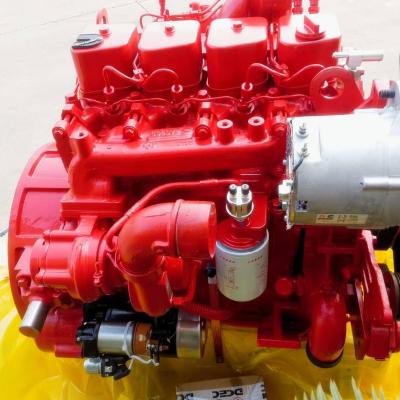
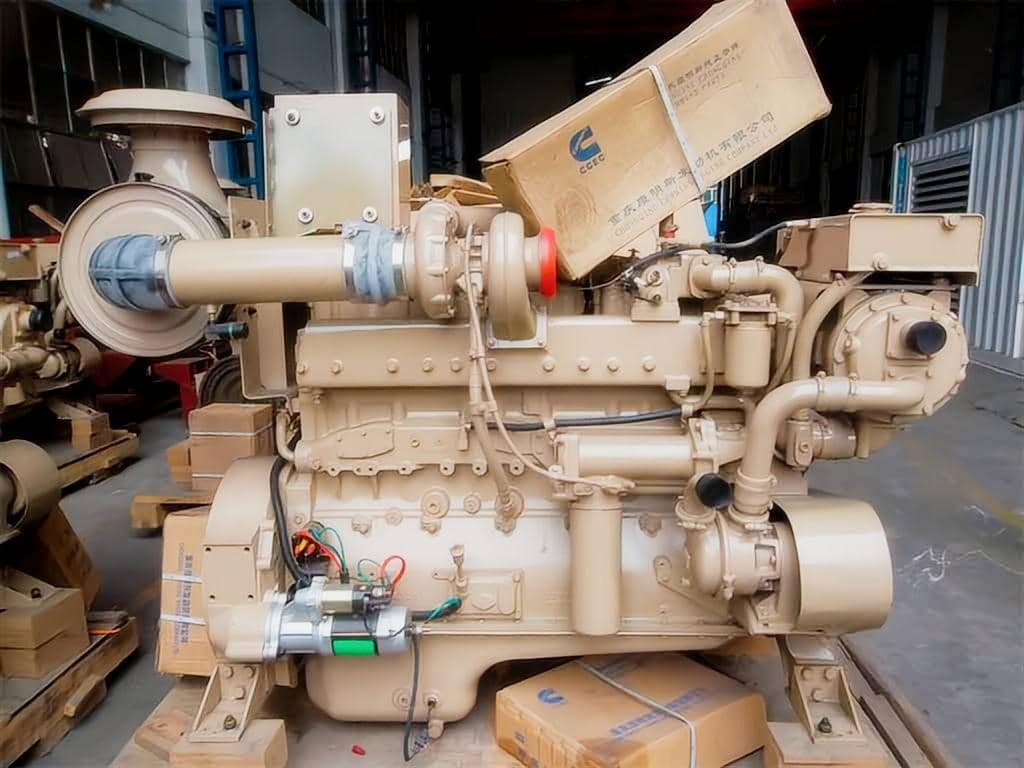
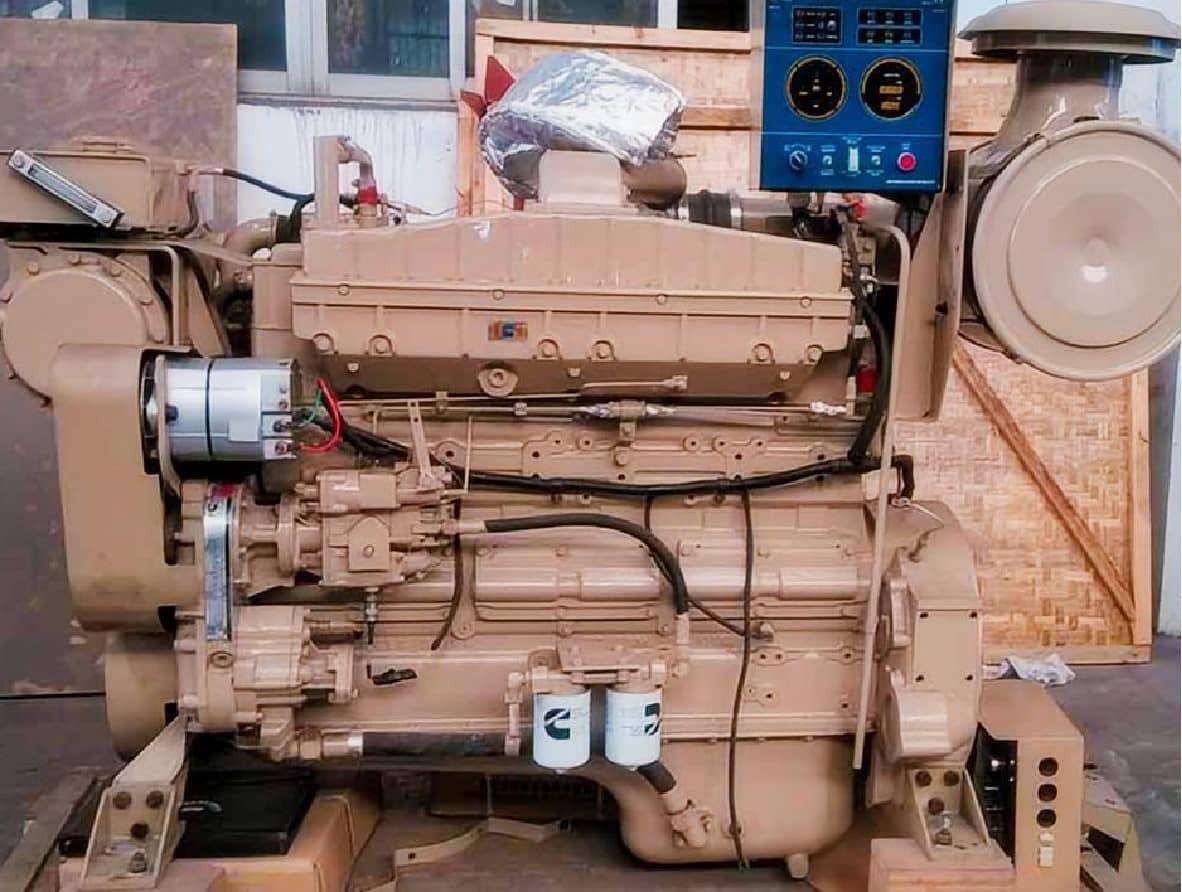
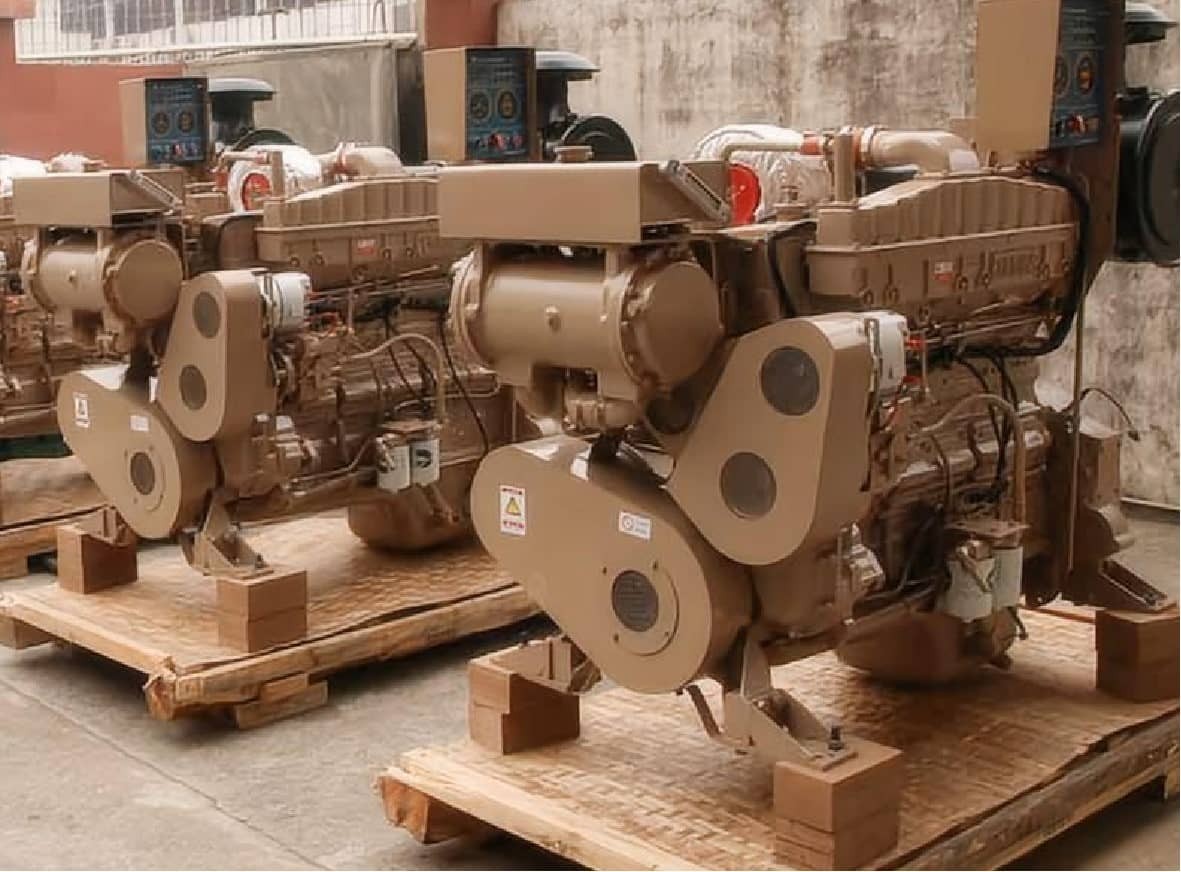
The Chongqing Cummins (CCEC) NTA855-DM264 is a heavy-duty, 14-liter, 6-cylinder inline diesel engine engineered specifically for marine auxiliary power and fixed-speed generator drive duties. Delivering a continuous prime rating of 264 kW (354 HP) at 1500 RPM and a standby capacity of 291 kW, this engine provides the mechanical shaft power required to drive 200 kW (250 kVA) 50 Hz shipboard generator sets under full marine classification standards.
Built with a proven 140 mm by 152 mm bore and stroke, the NTA855-DM264 develops 1681 Nm of torque. This robust mechanical output ensures fast frequency recovery during heavy inductive electrical motor starts on commercial vessels. As an international marine power supplier, HekoPower exports complete, factory-tested CCEC NTA855-DM264 engine assemblies built to the D093641MX02 configuration. Every complete engine features an engine-mounted plate heat exchanger, sea water pump, water-cooled exhaust manifold, and full China Classification Society (CCS) certification alongside IMO Tier II NOx emissions compliance.
Selecting the correct auxiliary engine requires precise technical matching between mechanical flywheel output and electrical alternator demand. Understanding how the NTA855-DM264 fits into the broader CCEC 14-liter engine lineup prevents costly over-specifying or dangerous engine underloading.
The NTA855-DM264 operates at a prime power rating of 264 kW at 1500 RPM, whereas the NTA855-DM284 delivers 284 kW at the exact same rotational speed. The primary structural difference lies in the CPL injector fuel flow calibration within the Pressure-Time (PT) fuel system and turbocharger boost matching.
Selecting the 264 kW DM264 model over the 284 kW variant is critical when matching a standard 200 kW marine alternator. Running a 284 kW engine on a 200 kW electrical load forces the engine to operate continuously below its optimal thermal load threshold. This causes unburned fuel accumulation, exhaust valve carbon fouling, and a condition known as wet stacking. The NTA855-DM264 operates perfectly within its peak thermal efficiency zone for a 200 kW alternator, lowering the fuel consumption curve and maintaining clean combustion.
A common error in marine repowering is attempting to adapt a main propulsion engine for generator duty. Main propulsion engines utilize variable-speed governors designed to follow a propeller power curve across changing engine speeds.
The NTA855-DM264 features a specialized constant-speed mechanical governor matched specifically to CPL CQ125. This setup responds instantly to sudden electrical load steps at a fixed 1500 RPM. It holds the engine speed drop well within strict marine classification tolerances, ensuring the alternator output remains at a stable 50 Hz.
Marine alternators typically operate at an efficiency between 90 percent and 93 percent with a 0.8 power factor. Generating 200 kW of continuous electrical power requires approximately 215 kW to 222 kW of mechanical shaft power directly from the engine flywheel.
With a prime rating of 264 kW, the NTA855-DM264 offers a 15 to 20 percent mechanical power reserve. This reserve absorbs mechanical friction, alternator cooling fan resistance, and the massive initial current surges that occur when starting heavy onboard pumps, deck winches, or air conditioning compressors.
The rigid cast-iron block and mechanical PT fuel system make the NTA855-DM264 a highly durable solution for remote and demanding marine operations where complex electronics fail.
Deep-sea fishing vessels rely on continuous auxiliary power for fish hold slurry pumps, deck hydraulics, and heavy freezing units. The NTA855-DM264 operates continuously under grueling 24/7 load cycles, easily handling the marine gas oil (MGO) variations often found in remote port bunkering. Its water-cooled exhaust manifold significantly reduces ambient engine room temperatures, protecting surrounding wiring harnesses and control panels from heat degradation.
Offshore support vessels experience violent, sudden electrical load changes during dynamic positioning and maneuvering operations. The 1681 Nm torque capacity of the NTA855-DM264 allows ship generators to accept heavy load steps without voltage sags or frequency dips. This keeps critical navigation equipment and bow thruster control systems fully operational during heavy seas.
When rated at its standby output of 291 kW, the NTA855-DM264 serves as a highly dependable emergency generator driver. It accepts rapid cold starts and assumes full shipboard emergency power loads within seconds of a primary power loss, meeting the strict requirements of international maritime safety codes.
Following proper maintenance schedules and installation guidelines ensures the NTA855-DM264 reaches its expected 25,000 to 30,000-hour major overhaul lifespan before requiring block removal.
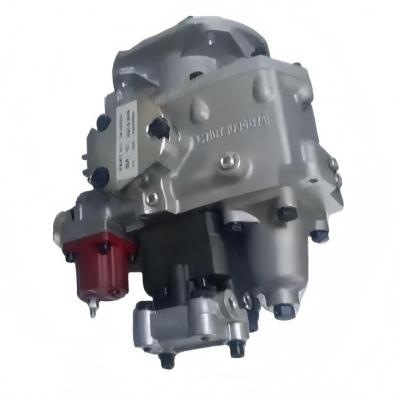
Consistent fluid and filter management is the foundation of marine diesel longevity. Operators must replace the spin-on fuel filters and engine oil filters every 250 operating hours. During this interval, it is crucial to inspect the mechanical PT fuel pump supply pressure to verify consistent injector delivery across all six cylinders.
Cooling circuit care prevents catastrophic overheating. The titanium or cupronickel plate heat exchanger requires annual descaling to remove marine growth. Mechanics should regularly inspect the seawater pump flexible impeller and maintain proper DCA4 coolant corrosion inhibitor levels to prevent wet cylinder liner pitting. Finally, operators must check and adjust valve clearances and PT injector stroke according to CPL CQ125 specifications every 1500 operating hours.
Verify the existing bedplate matches the standard SAE 1 flywheel housing and 14-inch flywheel configuration of build code D093641MX02.
Check raw water inlet piping diameters to prevent seawater pump suction restriction, and ensure flexible exhaust bellows match the water-cooled manifold outlet flange.
Align the engine crankshaft to the alternator shaft using precision laser alignment tools, maintaining tolerances strictly within 0.05 mm before torquing the coupling bolts.
Prime the PT fuel pump and conduct a staged load-bank test, monitoring exhaust gas temperatures and oil pressure before synchronizing with the main shipboard bus.
Many buyers assume the NTA855-DM264 can be converted from 1500 RPM (50 Hz) to 1800 RPM (60 Hz) simply by turning the governor speed screw. While the 14L block physically handles 1800 RPM, running a 1500 RPM CPL CQ125 engine at 1800 RPM alters injection timing, turbocharger boost points, and internal balance weights. Converting operating frequencies requires replacing PT pump metering components, turbocharger housings, and CPL specifications to prevent excessive exhaust gas temperatures and catastrophic piston failure.
A persistent misconception is that electronic common-rail engines are universally superior to mechanical PT pump engines in marine environments. While electronic engines meet strict automotive-style emissions, the mechanical PT fuel pump on the NTA855-DM264 provides unmatched survivability at sea. It contains no delicate engine control units (ECUs), high-pressure common rail sensors, or complex wiring harnesses that frequently short out in moist, salty ocean air.
Vessel owners often assume a 264 kW prime engine rating generates exactly 264 kW of electrical power. The 264 kW rating actually specifies the mechanical output at the engine flywheel. Once you factor in generator efficiency losses and mechanical drag, the continuous electrical output of the complete generator set drops to 200 kW. Sizing an alternator at 264 kW for this engine will result in stalling under heavy load.
To support complete shipboard power system design, HekoPower exports the full range of Chongqing Cummins 14-liter auxiliary power units. Whether your commercial vessel requires standard 50 Hz power nodes or specialized 60 Hz configurations, our marine engineering team provides complete technical matching, CAD dimensional drawings, and drop-in repowering guidance. Our inventory covers varying power demands, ensuring you never have to compromise on auxiliary power sizing.
Cummins N855-DM Series, Marine Auxiliary Engines for commercial and recreational applications, original products from Chongqing Cummins Engine Plant(CCEC). This series mainly includes NT855-DM180, NT855-DM205, NT855-DM230, NT855-DM240, NTA855-DM264, NTA855-DM284, NTA855-DM287, NTA855-DM306, NTA855-DM313,NTA855-DM317. All engines complete with sea water pump, heat exchanger, CCS/IMO certificates.
HekoPower supplies the original CCEC NTA855-DM264 with full China Classification Society (CCS) inspection documentation and IMO Tier II NOx emission compliance certificates as standard. International classification certificates including ABS, BV, DNV, and LR can be coordinated and issued prior to factory dispatch upon request.
Standard factory production, marine load testing, and classification inspection take approximately 10 to 15 business days. Export packing in heavy-duty wooden cases and sea freight logistics are managed directly by HekoPower to ensure safe, rapid delivery to your designated port.
Yes. Every complete NTA855-DM264 auxiliary engine assembly includes a factory-mounted plate heat exchanger, raw seawater pump, expansion tank, water-cooled exhaust manifold, and a 24V electric starter motor. The engine arrives fully ready for alternator coupling and bedplate installation.