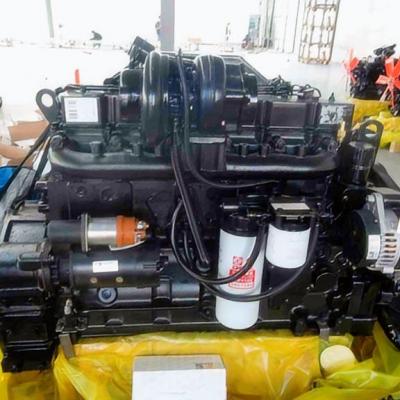
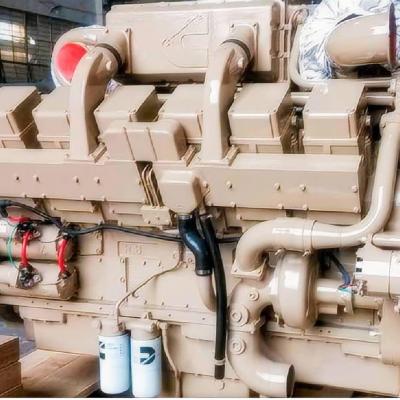
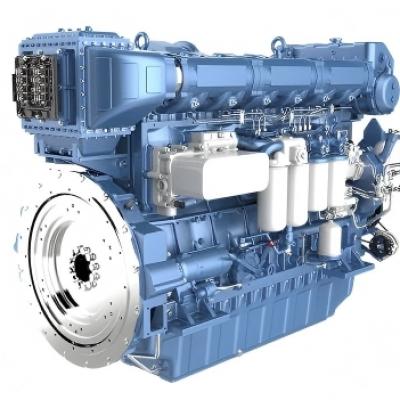
The Deutz BF8M1015C-G2 is a 15.874-liter, water-cooled, turbocharged and intercooled stationary generator drive engine calibrated for 1500 rpm (50 Hz) power generation. Rated at 403 kW prime and 448 kW standby under Euro II emissions compliance, it is manufactured by Hebei Huabei Diesel Engine Company (Huachai), the licensed Deutz AG production plant in China operating under German technical transfers since 1979.
Built on a compact 90-degree V8 block measuring just 1151 mm in length, the engine pairs individual Electronic Unit Pump (EUP) injection with wet-liner serviceability to hold 205 g/kWh rated fuel consumption. HekoPower supplies factory-tested complete BF8M1015C-G2 G-Drive assemblies, radiator-mounted power packs, and direct-fit replacement engines for OEM genset packagers and industrial fleet operators.
Within Huachai's 1500 rpm 8-cylinder generator range, the BF8M1015C-G2 occupies the upper tier of the standard C-calibration before stepping into higher-boost CP models. Compared with the entry BF8M1015C-G1A, it adds roughly 23 kW of prime headroom to comfortably cover 450 kVA continuous-duty alternators without straining exhaust gas temperatures.
Buyers frequently confuse the BF8M1015C-G2 with the BF8M1015CP-G2 because both datasheets show 448 kW. On the C-G2, 448 kW is the emergency standby limit above a 403 kW prime baseline; on the CP-G2, 448 kW is the prime rating with a 490 kW standby ceiling. Choosing the C-G2 for a 450 kVA prime / 500 kVA standby package trims rated fuel consumption from 208 g/kWh down to 205 g/kWh while reducing peak cylinder thermal loading.
Frequency suffixes also separate otherwise identical castings. The BF8M1015C-G1B delivers 408 kW at 1800 rpm for 60 Hz networks, whereas the G2 suffix locks timing, turbocharger match, and governor response strictly to 1500 rpm for 50 Hz electrical grids. Do not conflate this generator drive with the variable-speed BF8M1015C construction engine (364–400 kW at 1900–2100 rpm with a 2640 Nm peak torque curve at 1200 rpm) or the CCS/IMO-certified BF8M1015-MC marine auxiliary model (364 kW continuous at 1800 rpm).
After deducting roughly 8.7 to 9.3 kW for a belt-driven tropical radiator fan and accounting for ~95% brushless alternator efficiency, the BF8M1015C-G2 net flywheel output matches 450 kVA prime (360 kWe) and 500 kVA standby (400 kWe) three-phase 50 Hz generator sets. Its short 1151 mm block length makes it practical for sound-attenuated 20-foot container builds, rooftop hospital emergency plants, commercial data halls, and remote mining camps where inline-six 15-liter engines require longer baseframes.
With electronic governing configured to ISO 8528-5 G2 performance standards, the engine accepts first-step block loads up to 60% without excessive frequency droop, supporting motor-starting currents on chillers, fire pumps, and quarry crushers. Fuel efficiency remains flat through typical field duty cycles, holding approximately 202 to 204 g/kWh between 50% and 75% load. A common procurement error is sizing a 500 kVA base-load plant against the 448 kW standby figure; standby power permits limited annual emergency hours under variable load, and running above 403 kW continuously accelerates cylinder liner and valve-seat wear. Buyers familiar with legacy Deutz FL413/513 engines also occasionally mistake the BFM1015 for an air-cooled unit, whereas the BF8M1015C-G2 relies on a pressurized liquid cooling loop and air-to-air charge cooler.
Reliable service life starts with protecting the EUP injection system and thermal margins. The 50-liter lubrication circuit (45-liter sump fill) requires engine oil meeting Deutz TR 0199-99-1217 standards, maintaining at least 3.0 bar oil pressure at 1500 rpm (shutdown threshold 2.7 bar) with sump temperatures kept below 130 °C. Keep fuel feed-pump suction head within 2 meters and fit high-efficiency water-separating primary filters, because moisture and particulate contamination rapidly score unit pump plungers.
During canopy retrofits or engine repowers, verify that the existing cooling package can dissipate roughly 216 kW of jacket-water heat plus 105 kW of charge-air heat across a ~102-liter filled cooling circuit. Maximum permissible coolant outlet temperature is 103 °C (105 °C warning, 108 °C shutdown) with an inlet-to-outlet delta no higher than 8 °C and external circuit pressure drop within 0.35 bar. Restrict exhaust backpressure and air intake resistance to 50 mbar each, and confirm an SAE 1 flywheel housing paired with a 14-inch, 167-tooth flywheel (counter-clockwise rotation facing the flywheel).
Avoid attempting a direct drop-in swap using a construction-spec BF8M1015C long-block without verifying full G-Drive trim. Even though overall footprint and 1060 kg dry base weight match, construction engines use variable-speed governing, different flywheel rotational inertia (2.264 kg·m² on genset builds), and torque-rise fueling maps that destabilize 50 Hz synchronization.
Within Huachai's BFM1015 generator lineup, the BF8M1015C-G2 sits directly between the 6-cylinder BF6M1015 models (230–365 kW range) and the higher-output BF8M1015CP series (413–560 kW), allowing OEMs to standardize mounts, filtration, and 24V electrical harnesses across 300 kVA to 650 kVA generator platforms.
Deutz BFM1015-Generator Engine Series, original products from Huachai Deutz Engine Plant. This series mainly includes BF6M1015-GA, BF6M1015C-G1A, BF6M1015C-G2A, BF6M1015C-G3A, BF6M1015C-G4A, BF6M1015-GB, BF6M1015C-G1B, BF6M1015C-G2B, BF6M1015C-G3B, BF6M1015CP-G, BF8M1015C-G1A, BF8M1015C-G1B, BF8M1015C-G2, BF8M1015CP-G1A, BF8M1015CP-G1B, BF8M1015CP-G2, BF8M1015CP-G3, BF8M1015CP-G4, BF8M1015CP-G5, BF8M1015CP-G2B, BF8M1015CP-G3B.
Accounting for roughly 9 kW of radiator fan draw and ~95% alternator efficiency at a 0.8 power factor, the 403 kW prime / 448 kW standby mechanical output pairs cleanly with a 450 kVA prime / 500 kVA standby 50 Hz synchronous alternator.
Both run at 1500 rpm on the same 15.874 L platform, but 448 kW is the standby ceiling on the BF8M1015C-G2 (403 kW prime, 205 g/kWh SFC) whereas 448 kW is the prime rating on the higher-boost BF8M1015CP-G2 (490 kW standby, 208 g/kWh SFC).
No. The G2 specification is factory-calibrated for 1500 rpm (50 Hz) operation; running 60 Hz equipment at 1800 rpm requires a dedicated 60 Hz build such as the BF8M1015C-G1B or factory governor and turbocharger recalibration.
Maximum continuous coolant outlet temperature is 103 °C (warning at 105 °C, shutdown at 108 °C) with external cooling resistance capped at 0.35 bar, while exhaust backpressure and air inlet restriction must each stay at or below 50 mbar.