Details
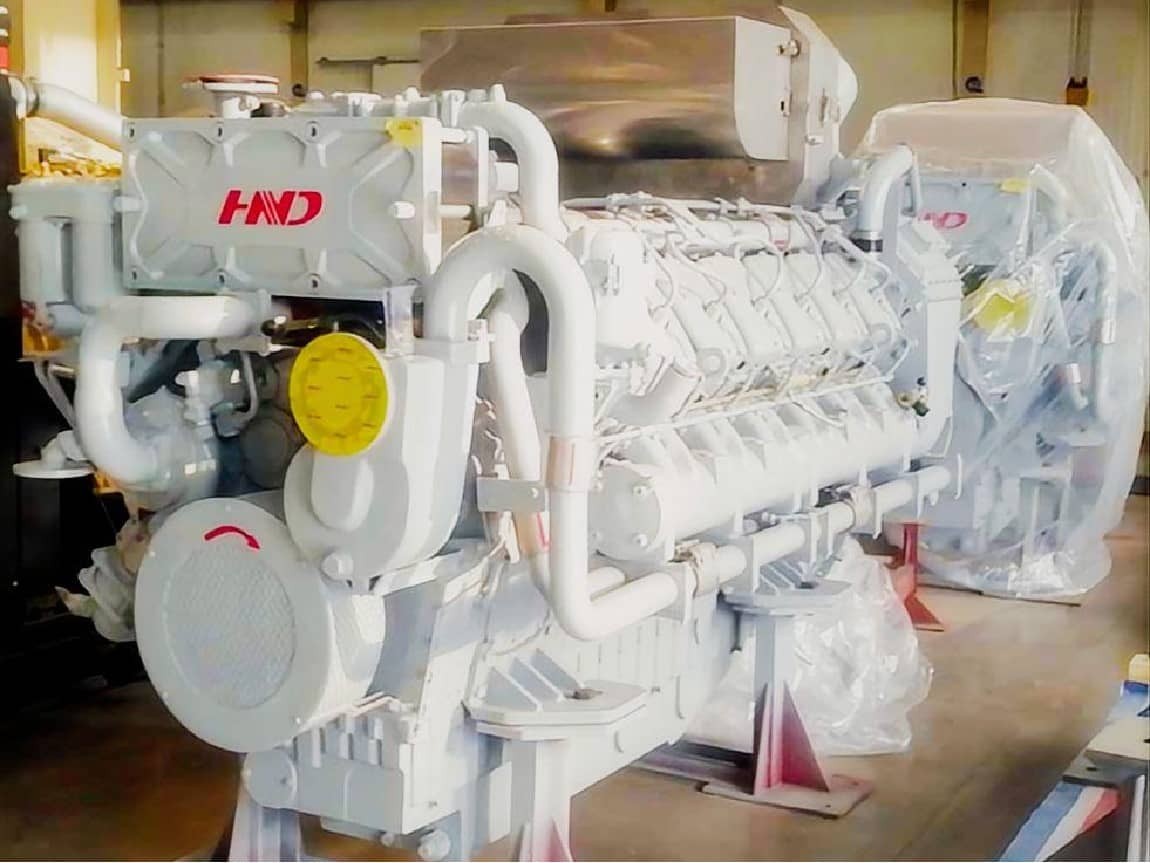
Deutz TBD620V12-1850HP Marine Propulsion Engine
Built by Henan Diesel Engine Plant (HND) under Deutz-MWM architecture, the Deutz TBD620V12-1850HP is a high-output, variable-speed marine main propulsion engine delivering 1380 kW (1850 HP) at 1800 rpm. Its 90-degree V12 block displaces 53.16 liters across a 170 mm bore and 195 mm stroke, pairing exhaust turbocharging with seawater charge-air intercooling for sustained commercial navigation under DIN ISO 3046-7 marine ambient conditions (45°C intake air and 32°C seawater).
HekoPower supplies complete, factory-tested TBD620V12-1850HP marine propulsion assemblies for newbuilds and vessel repowering projects. Each unit can be configured with CCS or IMO classification documentation, matched marine reduction gearboxes, and OEM cooling and governing packages tailored to shipyard machinery layouts.
Technical Specifications of Deutz TBD620V12-1850HP
General Engine Data
- Engine Model:
- Deutz TBD620V12-1850HP
- Type:
- 12 Cylinders, V Type 90°, 4 Stroke
- Displacement:
- 53.16 L
- Bore * Stroke:
- 170 * 195
- Wet Weight (with heat exchanger):
- 5100 Kg
- Overall Dimension:
- 2979mm*1450mm*2240mm
Key Performance Data
- Rated Power:
- 1380 kW/1850 HP
- Rated Speed:
- 1800 rpm
- Lubricant Oil Consumption:
- ≤1.4 g/kW.h
- Low Idle Speed:
- 650 rpm
- Fuel Consumption:
- 205 g/kW.hr
More Technical Data
- Certification:
- CCS/IMO Certificates
- Aspiration:
- Turbocharged and Intercooled
- Fuel System:
- Direct Injection Pump
- Compression Ratio:
- 13.5:1
- Starting Method:
- Electrical Start (12V/24V)
- Cooling Method:
- Water Cooled
- Governor Type:
- Electronic/Mechanical
How the TBD620V12-1850HP Compares Within the 620 Series
Within the V12 propulsion range, the 1850HP rating sits directly above the 1500 rpm TBD620V12-1680HP (1240 kW). Both engines share the identical 53.16 L displacement, 5100 kg wet weight, and 2979 mm length, but running at 1800 rpm extracts an extra 140 kW without enlarging the engine room. That power gain actually arrives at a slightly lower brake mean effective pressure (roughly 17.3 bar versus 18.7 bar on the 1500 rpm rating), trading a higher mean piston speed of 11.7 m/s (versus 9.75 m/s) and a deeper gearbox reduction ratio for greater propulsion density.
Naval architects often weigh the 1850HP V12 against stepping up to the V16 models (2240HP and 2500HP). Moving to a V16 adds roughly half a meter of engine-room length and over a metric ton of machinery mass, making the TBD620V12-1850HP the practical ceiling for hulls constrained by aft bulkhead clearance or stern buoyancy.
Buyers should also distinguish this propulsion unit from HND's constant-speed TBD620V12 marine auxiliary engines rated between 1251 kW and 1433 kW for 50 Hz or 60 Hz shipboard gensets. Although the core crankcase and 170 x 195 mm cylinder kits overlap, the 1850HP propulsion build uses variable-speed propeller-law fuel mapping, dedicated marine thrust/gearbox interfaces, and speed-range governing suited to continuous throttle transitions rather than fixed-frequency alternator paralleling.
Real-World Marine Application Scenarios
Harbor Tugboats, Pushers, and Offshore Utility Vessels
In 30- to 45-meter twin-screw tugs and anchor-handling workboats, rapid load acceptance from the 650 rpm low idle directly governs ship-assist safety. The direct-injection fuel system and dual-bank turbocharging build boost cleanly under sudden bollard-pull demand without excessive exhaust smoke or governor hunting. Its compact 1450 mm width leaves workable side walkways in tight twin-engine machinery spaces.
Coastal Cargo Carriers, Dredgers, and Self-Propelled Barges
Long-haul coastal freighters and sand-suction dredgers typically operate near 75% to 85% continuous output for thousands of hours per year. Under these steady propeller-law loads, the 13.5:1 compression ratio and intercooled charge air keep specific fuel burn predictable even in warm tropical waters.
One recurring operational misconception is that extended slow-steaming or idling below 25% rated load preserves engine life on a high-output 1800 rpm V12. Deutz-MWM operating practice advises against continuous operation below 25% load because depressed cylinder temperatures lead to wet stacking, fuel-diluted lube oil, and liner glazing; whenever low-load transit is unavoidable, crews should follow it with at least one hour near full rated load to burn off combustion deposits.
Maintenance and Vessel Repowering Guidance
The TBD620V12 cooling system holds approximately 120 liters of jacket coolant in a closed freshwater circuit paired with seawater heat exchangers. Keeping raw-water tube stacks free of scale and biofouling is critical so charge-air temperatures remain within the 32°C seawater design envelope. Pairing routine oil sampling with approved marine-grade diesel lubricants helps hold oil consumption well inside the ≤1.4 g/kW.h specification across extended voyages.
Because each cylinder uses an independent head alongside oil-cooled pistons, shipboard engineers can pull individual liners, inspect rings, or service injectors directly inside the hull without lifting the entire 5100 kg assembly. When repowering an existing vessel, verify that the propulsion driveline matches the engine's anti-clockwise crankshaft rotation (viewed from the flywheel end), calculate torsional vibration across the 650 to 1800 rpm operating band for the flexible coupling, and confirm whether your bridge telegraph requires a Woodward/Heinzmann electronic governor or a mechanical/hydraulic setup.
Some procurement teams hesitate over proven direct-injection mechanical architectures, assuming they struggle with modern survey approvals or spare-parts continuity. In practice, HND builds the TBD620V12-1850HP to satisfy CCS and IMO Tier II requirements (with SCR aftertreatment options for Tier III zones), and its standardized 170 mm-bore wear parts remain widely available worldwide for straightforward at-sea repairs.
Deutz TBD620 Marine Propulsion Series Lineup
Within HND's 620-series propulsion catalog, the TBD620V12-1850HP bridges the 1500 rpm V12 rating and the larger-displacement 16-cylinder engines, giving vessel designers high shaft power without crossing into a V16 footprint.
Deutz TBD620-Marine Propulsion Series, Marine Propulsion Diesel Engines for commercial and recreational applications, original products from Henan Diesel Engine Plant (HND). This series mainly includes TBD620V6-970HP, TBD620V8-1120HP, TBD620V12-1680HP, TBD620V12-1850HP, TBD620V16-2240HP, TBD620V16-2500HP.
Frequently Asked Questions
What is the practical difference between the TBD620V12-1850HP and the TBD620V12-1680HP?
Both models use the same 53.16 L V12 block, weight, and physical footprint. The 1850HP version increases rated speed from 1500 rpm to 1800 rpm to deliver 1380 kW instead of 1240 kW, making it better suited to faster hull profiles or vessels requiring maximum output from a compact engine room when paired with an appropriately higher gearbox reduction ratio.
Can the TBD620V12-1850HP propulsion engine directly replace a TBD620V12 marine auxiliary genset engine?
No. Although they share core mechanical components, the 1850HP propulsion model is calibrated for variable-speed propeller-law loads and marine gearbox coupling. For constant-speed 50 Hz or 60 Hz shipboard power generation, specify one of the dedicated TBD620V12 marine auxiliary ratings (1251 kW to 1433 kW) with isochronous or droop-matched alternator governing.
Which direction does the TBD620V12-1850HP crankshaft rotate for gearbox matching?
Standard HND Deutz TBD620V12 propulsion engines rotate anti-clockwise (counter-clockwise) when viewed facing the flywheel end. Confirm input rotation, flywheel housing interface, and torsional flexible coupling stiffness with your marine reduction gearbox supplier before installation.
What ambient conditions govern the 1380 kW continuous marine rating?
Under DIN ISO 3046-7 marine unlimited-navigation standards, the full 1380 kW output is rated for up to 45°C engine-room intake air and 32°C charge-air cooling seawater at 0.1 MPa atmospheric pressure. Vessels operating continuously in warmer engine rooms or higher seawater temperatures should review cooling-circuit sizing or power derating curves with HekoPower engineering.