Details
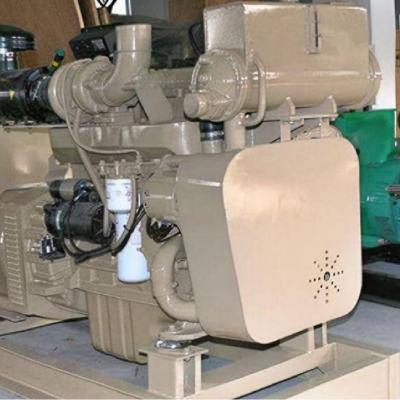
Deutz HC12V700/15C Marine Propulsion Diesel Engine
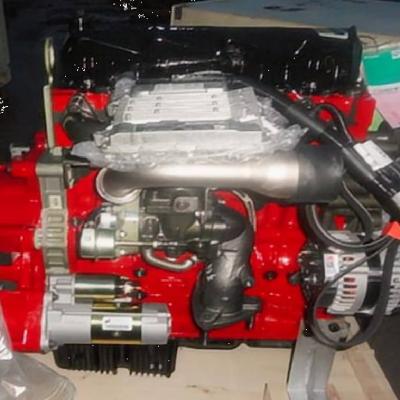
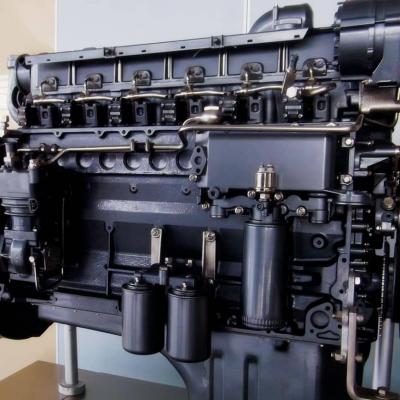
The Deutz HC12V700/15C is a 23.812-liter, 90-degree V12 marine main propulsion engine rated at 515 kW (700 metric HP) for continuous heavy-duty vessel operation. Built by Hebei Huabei Diesel Engine Co., Ltd. (Huachai), China's licensed Deutz production plant since 1979, this platform extends the proven 132 mm × 145 mm cylinder architecture of the German Deutz BFM1015 family into a twelve-cylinder marine block with individual cylinder heads and electronic unit pump (EUP) injection.
HekoPower Group supplies factory-new HC12V700/15C complete marine engine assemblies directly from the Huachai Deutz facility, configured with closed-loop heat exchanger cooling, water-to-air intercooling, SAE 1 flywheel interfaces, and ZY, CCS, or IMO class documentation ready for shipyard integration or commercial repower projects.
Technical Specifications
General Engine Data
- Engine Model:
- Deutz HC12V700/15C
- Type:
- 12 Cylinders, V type, 4 stroke
- Displacement:
- 23.812 L
- Bore * Stroke:
- 132 * 145
- Net Weight (with flywheel and alternator):
- 2000 Kg
- Overall Dimension:
- 1763mm*920mm*1174mm
Key Performance Date
- Rated Power:
- 515 kW/700 HP
- Rated Speed:
- 1800 rpm
- Low Idle Speed:
- 550 rpm
- Fuel Consumption (Running Speed):
- ≥ 195 g/kW.h
More Technical Data
- Certification:
- ZY/CCS/IMO Certificates
- Aspiration:
- Turbocharged and Intercooled
- Fuel System:
- EUP
- Compression Ratio:
- 16.5:1
- Starting Method:
- Electrical Start (28.5V/55A)
- Cooling Method:
- Heatexchanger and Water-air Intercooler
- Governor Type:
- Electronic/Mechanical
- Lubricant Capacity:
- Around 70 L
- Flywheel Size/ Housing:
- 14", SAE1
- Running Type:
- Continuous
How HC12V700/15C Compares Across the HC12V Lineup
Within the ten-model HC12V/C marine propulsion family, every unit shares the same 23.812-liter cast-iron V12 structure and 2,000 kg dry footprint. What separates the HC12V700/15C from its higher-output 1500 rpm siblings—the HC12V720/15C (529 kW) up through the HC12V800/15C (588 kW)—is cylinder loading. Delivering 515 kW at its factory 1500 rpm design speed puts the HC12V700/15C at a conservative brake mean effective pressure near 17.3 bar and a mean piston speed of 7.25 m/s, giving fleet operators wider thermal headroom and longer intervals between top-end overhauls than the 588 kW calibration.
Stepping up to the `/18C` propulsion sub-series (HC12V820/18C through HC12V952/18C, spanning 603 kW to 700 kW at 1800 rpm) raises mean piston speed to 8.70 m/s to favor lighter hulls and higher transit speeds. By contrast, the `/15C` rating suits heavy displacement vessels that require steady shaft torque—roughly 3,279 N·m at 1500 rpm—without pushing turbocharger and exhaust temperatures near continuous limits.
Shipyards should also distinguish the `/C` propulsion engines from Huachai's HC12V/D marine auxiliary lineup (such as the HC12V748/15D and HC12V898/15D). While both share core block geometry, `/D` units are governed strictly for fixed-speed 50 Hz or 60 Hz shipboard generator duty, whereas the HC12V700/15C is calibrated for variable-speed propeller-law loading and rapid thrust transitions.
Marine Propulsion Applications and Load Behavior
The HC12V700/15C fits continuous commercial hulls where engines log 3,000 to 6,000 hours annually under steady 75% to 90% load factors. Typical installations include 800 to 1,200 DWT single-screw inland cargo barges, 1,500 to 2,500 DWT twin-screw river freighters, steel coastal trawlers, harbor pusher tugs, and commuter passenger vessels operating on fixed daily timetables.
Because the V12 holds a stable 550 rpm low idle, captains can engage marine reduction gearboxes cleanly during tight docking or low-speed net hauling without stalling or excessive torsional vibration. Along a standard cubic propeller curve, cruising at 75% continuous power keeps fuel burn in the range of 90 to 95 liters per hour, rising to approximately 120 liters per hour at full 515 kW output depending on diesel density and hull fouling.
Two common specification errors come up during vessel sizing. First, "700 HP" in Huachai's nomenclature denotes metric horsepower (700 PS, equal to 515 kW or 691 mechanical bhp); naval architects calculating propeller pitch in imperial horsepower should base shaft load on 515 kW rather than 700 bhp to prevent over-propping. Second, a `/15C` engine cannot simply be turned up to 1800 rpm on sea trials to match an `/18C` model—fuel delivery maps, turbocharger trim, and torsional damping are matched specifically to the 1500 rpm continuous envelope.
Maintenance Practices and Repower Installation Notes
Serviceability in cramped engine rooms is a major practical advantage of this BFM1015-derived design. Each of the twelve cylinders uses an individual cylinder head ("one cylinder, one head"), allowing marine engineers to pull a single head, liner, or piston assembly for inspection without disturbing adjacent cylinders or needing heavy overhead gantry clearance across a full bank.
The roughly 70-liter lubrication sump should be filled with API CF-4 or higher marine diesel oil, with oil analysis and filter changes scheduled around fuel sulfur content and load hours. Because the engine relies on an EUP fuel system—individual high-pressure unit pumps mounted close to each cylinder—keeping water and sediment out of the fuel rail is critical. Always fit a dedicated primary oil-water separator ahead of the engine's fine fuel filters, and verify injector opening pressure (nominally 29 MPa) during major overhauls. Buyers sometimes assume EUP engines require electronic helm controls, yet Huachai builds the HC12V700/15C with either a mechanical or electronic governor: mechanical governors simplify remote cable throttles on single-screw workboats, while electronic governing is the better choice on twin-screw vessels needing synchronized shaft speeds.
On the cooling side, the closed freshwater jacket circuit protects the block and heads from saltwater corrosion, while raw water circulates only through the heat exchanger and water-to-air intercooler. Inspect sacrificial zinc anodes regularly and descale raw-water tube bundles before jacket coolant approaches its 103 °C maximum limit. For repower projects, verify engine-bed clearance against the 1,763 mm × 920 mm × 1,174 mm envelope, pair the SAE 1 flywheel housing and 14-inch flywheel with a properly rated torsional flexible coupling before bolting up the marine reduction gearbox, and size the 24V starting bank to match the 28.5V/55A charging alternator.
Deutz HC12V/C-Marine Propulsion Series
As the baseline continuous rating in the HC12V/C propulsion family, the HC12V700/15C gives vessel owners who do not need 600+ kW access to the same V12 balance, parts commonality, and classification support found across the rest of the series.
Deutz HC12V/C-Marine Propulsion Series, Marine Propulsion Diesel Engines for commercial and recreational applications, original products from Huachai Deutz Engine Plant. This series mainly includes HC12V700/15C, HC12V720/15C, HC12V750/15C, HC12V780/15C, HC12V800/15C, HC12V820/18C, HC12V850/18C, HC12V880/18C, HC12V898/18C, HC12V952/18C.
Frequently Asked Questions
What does the "/15C" designation mean on the Deutz HC12V700/15C?
In Huachai Deutz marine nomenclature, "15" identifies the 1500 rpm rated speed class and "C" denotes a main marine propulsion engine rated for continuous propeller-law service. Models ending in "/18C" are calibrated for 1800 rpm propulsion, while "/15D" and "/18D" units are marine auxiliary generator engines.
Which marine gearboxes match the HC12V700/15C flywheel interface?
The engine is built with an SAE 1 flywheel housing and a 14-inch flywheel. Any heavy-duty marine reduction gearbox rated for continuous input above 3,279 N·m at 1500 rpm with an SAE 1 bellhousing and matching 14-inch elastic torsional coupling can be paired, with reduction ratios typically selected between 3:1 and 5:1 for displacement hulls.
When should a shipyard choose the electronic governor over the mechanical governor?
Specify the electronic governor on twin-screw vessels or multi-station bridge setups where accurate port-and-starboard rpm synchronization and tighter speed holding matter. For single-screw cargo barges or fishing boats running mechanical throttle cables in remote regions, the mechanical governor keeps troubleshooting and onboard spare parts simpler.
Can the HC12V700/15C operate continuously in warm or silty coastal waters?
Yes. The closed freshwater heat exchanger isolates the engine block and twelve individual cylinder heads from seawater corrosion and silt buildup. Operators running in warm or muddy rivers should install oversized dual raw-water strainers and schedule routine heat-exchanger and water-air intercooler flushing to keep jacket coolant well below the 103 °C limit.