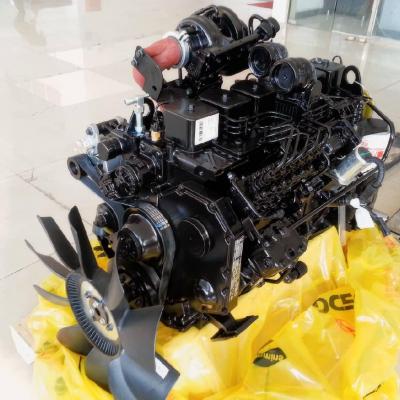
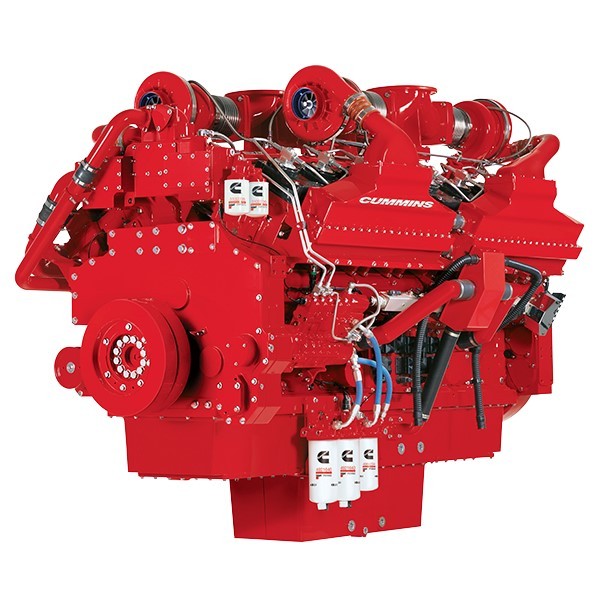
Details
Cummins QSK60-M Marine Propulsion Engine: Heavy-Duty 2700HP V16 Power Strategy
Marine operators and vessel shipyards requiring continuous, high-output power turn to the Cummins QSK60-M marine engine. Engineered by the Chongqing Cummins Engine Company (CCEC), this 60.2-liter V16 diesel engine delivers up to 2013 kW (2700 HP) at 1900 RPM. It provides the heavy-duty torque necessary for demanding ocean-going and commercial watercraft operations.
HekoPower supplies factory-original CCEC QSK60-M marine propulsion units globally. We deliver complete propulsion packages tailored to your hull design, operational profile, and classification requirements.
Tech Specs of Cummins QSK60-M
General Engine Data
Engine Model: Cummins QSK60-M
Type: 60° vee, 16-cylinder
Displacement: 60 L
Bore * Stroke: 159 * 190
Net Weight (with flywheel & alternator): 8754 Kg
Overall Dimension: 3375mm*1760mm*2402mm
Key Performance Data
Rated Power: 2013 kW/2700HP
Rated Speed: 1900 rpm
Rating Type: Intermittent Duty
Fuel Consumption (Running Speed): 336 L/hr
Torque/Speed: 8267 N.m (11208) @ 1500 rpm
Turbo Arrangement: Two-Stage
More Technical Data
Emission Rating: EPA Tier 3 and IMO Tier 2
Aspiration: Turbocharged and aftercooled
Compression Radio: 14.5:1
Fuel Injection: High Pressure Common Rail
Starting System: Electrical Start (24V)
Lowest Starting Temp Without auxiliary system: -12℃
Cooling Method: Heat exchanger or keel cooling
Architectural Distinctions and Technical Comparisons
Choosing the right heavy-duty propulsion platform requires understanding how the QSK60-M differs from older mechanical engines and smaller displacement units.
QSK60-M vs. Legacy KTA50-M Systems
The older Cummins KTA50-M relies on mechanical PT fuel injection across a 50-liter displacement block. In contrast, the QSK60-M expands cylinder volume to 60.2 liters across a 159 x 190 mm bore and stroke.
The primary operational difference lies in fuel delivery. The QSK60-M utilizes a Modular Common Rail System (MCRS). MCRS maintains ultra-high injection pressures regardless of engine speed. This eliminates black smoke during acceleration, reduces combustion noise, and improves brake specific fuel consumption (BSFC) across all throttle positions.
Twin-Stage Turbocharging vs. Single-Stage Design
Standard heavy-duty diesels often suffer from thermal buildup and slow throttle response when pulling heavy loads from a standstill. The QSK60-M features a twin-stage turbocharger configuration with water-to-air aftercooling.
Primary turbochargers force pressurized air into secondary units, feeding cooler, higher-density air into the 16 combustion chambers. This design lowers exhaust gas temperatures (EGT), preserves component life during continuous 24/7 duty cycles, and provides immediate torque response when maneuvering in tight harbor conditions.
Real-World Application Scenarios and Vessel Matching
The QSK60-M is designed specifically for high-load, continuous-duty marine applications where engine failure or unexpected downtime is not an option.
Heavy-Duty Tugboats and Workboats
Harbor tugs and pushboats demand maximum bollard pull at low engine speeds. The QSK60-M 2700HP configuration provides the flat torque curve required to hold heavy barges against swift currents. Its 8754 kg dry weight provides structural rigidity without compromising vessel draft limits.
Offshore Supply Vessels (OSVs) and Crew Ships
Offshore supply vessels operating near offshore platforms require precise positioning and sustained cruising speeds. The QSK60-M electronic fuel control integrates with dynamic positioning (DP) systems. It adjusts instantly to sudden power demands caused by ocean swells or thruster engagements.
Vessel Repower and Gearbox Matching
Replacing an aging marine engine with a QSK60-M requires careful mechanical alignment. HekoPower assists marine engineers with gearbox ratio matching and propeller pitch calculations.
Whether paired with a heat exchanger cooling loop or a keel cooling setup, the QSK60-M fits standard heavy-duty marine reduction gears. This makes it an ideal drop-in replacement for older commercial vessel repowers.
Operational Maintenance and Component Replacement Guidelines
Proper maintenance ensures the QSK60-M reaches its designed operational lifespan of tens of thousands of hours before requiring a major overhaul.
MCRS Fuel System Care
High-pressure common rail components operate under extreme pressures exceeding 1600 bar. Contaminated diesel will damage fuel injectors and high-pressure pumps.
Engineers must install primary fuel-water separators with 2-micron secondary filtration. Drain water collection bowls daily, and replace fuel filter elements strictly every 250 operating hours.
Cylinder Kit and Overhaul Strategies
When the engine approaches its scheduled overhaul interval, replacing worn components with genuine CCEC QSK60-M overhaul parts is essential for retaining marine class certification.
Always replace cylinder liners, pistons, rings, and main bearings as matched sets. Using non-genuine aftermarket components risks premature liner pitting, oil consumption spikes, and structural failure under full power.
Common Misconceptions Regarding the QSK60-M
Understanding these technical myths helps shipowners make informed equipment decisions.
Myth 1: Keel Cooling Reduces Engine Horsepower
Some marine operators believe that routing engine coolant through hull-mounted keel cooler channels reduces total usable horsepower compared to heat exchanger cooling.
This is inaccurate. The QSK60-M maintains its full 2013 kW (2700 HP) rating under both cooling configurations, provided the keel cooler system is sized correctly to dissipate thermal output at maximum continuous rating (MCR).
Myth 2: Common Rail Engines Cannot Handle Field Maintenance
A common worry is that electronic engines are impossible to repair at sea without specialized diagnostic teams.
In reality, the QSK60-M self-diagnostic system identifies fault codes instantly on marine panel displays. This allows onboard engineers to replace individual electronic control modules (ECMs) or sensors quickly using simple hand tools.
Myth 3: High-Displacement V16 Engines Always Consume More Fuel
Displacement alone does not dictate fuel burn rate. Because the 60.2L V16 engine operates at lower thermal stress levels and uses MCRS precise fuel metering, its fuel efficiency per horsepower-hour often beats smaller, highly stressed V12 engines forced to run near their thermal limits.
Cummins QSK60-M Sourcing FAQ
What does the 'M' suffix denote in the Cummins QSK60-M engine designation?
The 'M' suffix explicitly designates the engine for marine applications. This means the base QSK60 industrial block is modified with water-cooled exhaust manifolds, marine-grade electrical systems, corrosion-resistant paint coatings, and specific oil pan geometries designed to operate reliably at extreme vessel heel angles.
Can this engine be configured as an auxiliary unit rather than primary propulsion?
Yes. While widely used as a main propulsion unit, the engine is frequently configured as a high-output auxiliary unit. A Cummins QSK60-M 1900 RPM marine auxiliary engine price quote typically includes a constant-speed governor system designed to drive large-scale marine generators or high-capacity emergency fire pumps.
How does HekoPower ensure the authenticity of its Cummins engine assemblies?
Every engine supplied by HekoPower is an authentic assembly traceable directly to the manufacturing plant database. Each unit carries a unique engine serial number (ESN) stamped on the physical data plate, allowing international ship owners to verify manufacturing history, parts listings, and warranty parameters at any official Cummins service location worldwide.
What are the primary structural differences between CCEC Cummins and imported US variants?
Chongqing Cummins (CCEC) produces these engines under direct license and technology sharing agreements from Cummins Inc. USA. The structural materials, engine design drawings, metallurgy, and testing standards are identical. The principal variance is regional manufacturing localization, which gives CCEC units a considerable cost advantage and shorter production lead times for shipbuilders based in Asia, Europe, and the Middle East.
What information is required to receive an accurate QSK60-M Cummins price quote?
To get an accurate commercial quote, please provide your required power rating (HP/kW), intended engine speed (1800 or 1900 RPM), required marine classification society certificates (such as BV, ABS, CCS, or DNV), and details on the cooling system layout (keel-cooled or heat exchanger). This allows our team to build a comprehensive quotation matching your specific hull requirements.